Game generation
The engine is learning to dream: AI models as game generators
For forty years a game engine has drawn what a designer placed. The next generation will draw what a player imagines. That changes who makes games, and what a game is.
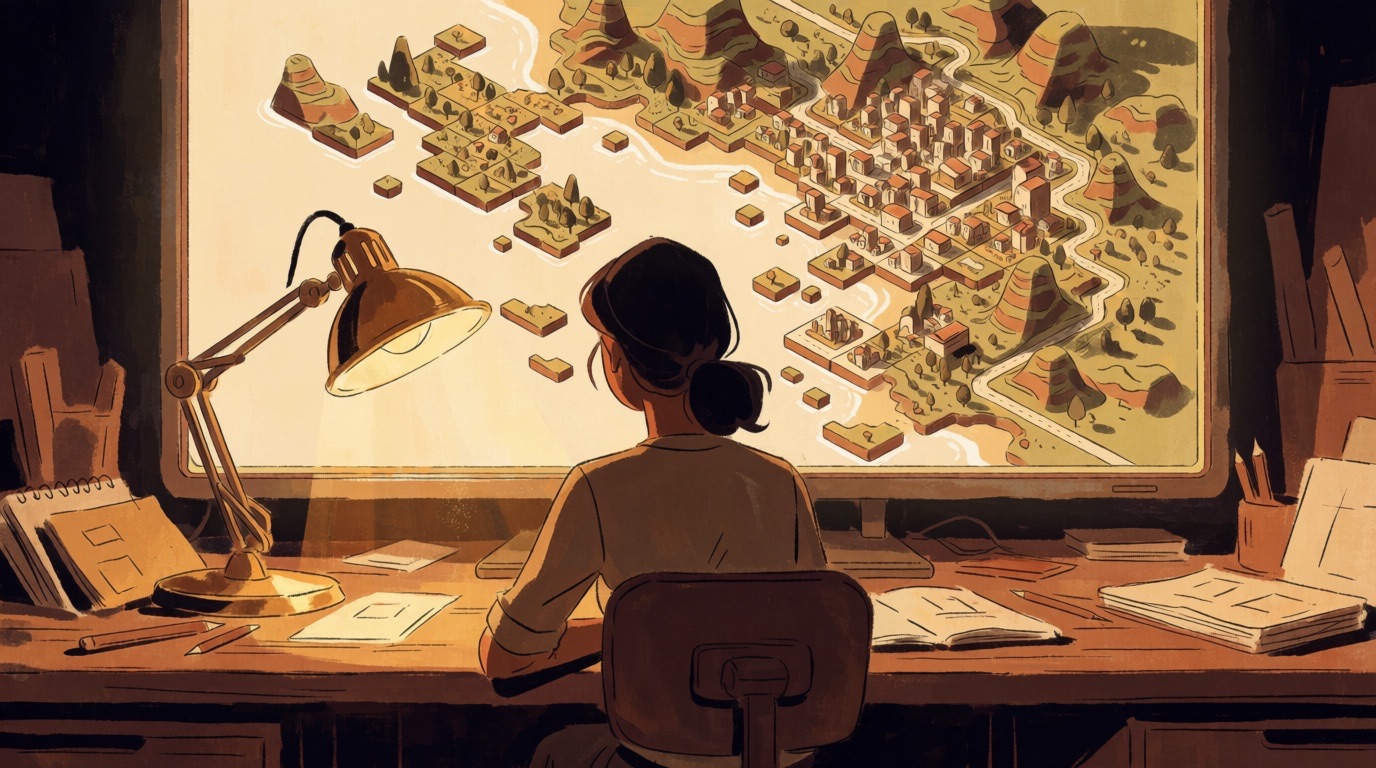
Every game you have ever played was, at some level, a lookup table. An artist modelled the door, a designer placed it, a programmer wrote what happens when you open it. The engine’s job was to render those decisions fast enough that they felt alive. That model of making games has produced extraordinary work, but it has one fixed ceiling: a world can only contain what a team had the time and money to build.
Generative models remove that ceiling. Not all at once, and not evenly, but the direction is now clear. The same family of systems that learned to write prose and paint images is learning to produce levels, characters, dialogue, rules and, in research labs, entire playable frames of video that respond to a controller. The engine is starting to dream.
From assets to intent
The first wave of AI in games was about assets: faster concept art, texture variations, voice prototypes. Useful, but it left the shape of production untouched. A team still decided everything up front, and the model simply filled in the blanks more cheaply.
The second wave, the one now arriving, is about intent. Instead of asking a model for a sword, you describe a situation: a flooded market town where the guards have stopped being paid. The system returns not a picture but a set of working parts: a map, a cast with motives, a few tensions waiting to break, and the rules that connect them. The designer’s role shifts from placing every object to shaping the space of what can happen.
The unit of game design is moving from the object to the situation.
That shift matters because players do not remember objects. They remember situations: the ambush they talked their way out of, the friend who betrayed them, the shortcut nobody else found.
Three layers of a generated game
When we design generative systems at Senrama we think in three layers, and we find it clarifies most debates about what AI can and cannot do yet.
- The canon layer. The fixed truths of a world: its history, its geography, its tone, the characters who must exist. This is authored, curated and versioned like any other creative work. It is where a studio’s voice lives.
- The simulation layer. The rules that govern change: economies, relationships, time, reputation. Some of this is classic code, some is model-driven, and the art is in deciding which is which.
- The performance layer. What the player actually sees and hears in the moment: the line of dialogue, the description of a room, the next scene. This is where large models are already strongest, because they can perform in character, on demand, at any length.
Most disappointing AI game demos try to make the performance layer do everything. The model is asked to remember the world, enforce its rules and entertain the player all at once, and it drifts. The worlds that hold together give each job to the right part of the stack.
What changes for players
For players the headline is simple: the game notices you. A generated world can react to choices nobody on the team anticipated, because it is not choosing between pre-written branches. It is composing a response within the rules of its canon.
That brings new kinds of play. Conversation becomes a mechanic rather than a menu. Replays diverge meaningfully. A world can be shared between players and still feel personal, because the same town can tell each visitor a slightly different story about itself.
It also brings new responsibilities. A world that can say anything has to be taught what it should never say. Safety, tone and consistency are no longer QA tasks at the end of a project; they are design materials from the first day.
What changes for studios
The cost curve of content inverts. Breadth becomes cheap and coherence becomes the premium. The studios that thrive will be the ones that are excellent at the canon layer: at worldbuilding, at character, at taste, and at the tooling that lets a small team keep a generative world on-model.
This is why we built Montage around two tools rather than one. Muse helps a creator author the canon: the world, its people and its rules. Motif lets a player step inside a world and play it, with the performance generated live but anchored to what Senrama, as the creator, wrote. The creator stays the author; the model becomes the cast and crew.
The honest limits
None of this is finished. Models still forget, contradict themselves and drift in tone over long sessions. Real-time generation is expensive, and latency is the enemy of play. Fully generated, frame-by-frame interactive video is impressive in research but not yet something you would ship as a product people play for a hundred hours.
But every one of those limits is an engineering problem with a visible trend line, not a wall. The interesting question is no longer whether games will be generated. It is what we want them to be when they can be anything.
Our answer: worlds with a point of view, authored by people, performed by machines, and shaped by the players who walk through them.