World models
AMD's Micro-World 2: an open real-time world model
AMD has released Micro-World 2, a 5B-parameter interactive world model that streams video at over 30 frames per second on one Instinct MI350X GPU. The weights, dataset and training code are all public.
Chip makers are starting to publish world models of their own. On 21 October AMD released Micro-World 2, an action-controlled world model that generates video as you steer it with keyboard and mouse, and runs in real time on a single AMD Instinct MI350X GPU.
What AMD released
Micro-World 2 is a 5-billion-parameter model built on Wan2.2 TI2V-5B. You give it a first frame, a text prompt and a stream of keyboard and mouse actions. It returns video at 352 × 640, one chunk at a time, using only what it has already generated and the controls you are pressing.
AMD has published the model checkpoints on Hugging Face under an OpenRAIL licence. It has also released the training and inference code, and the dataset it trained on.
How it works
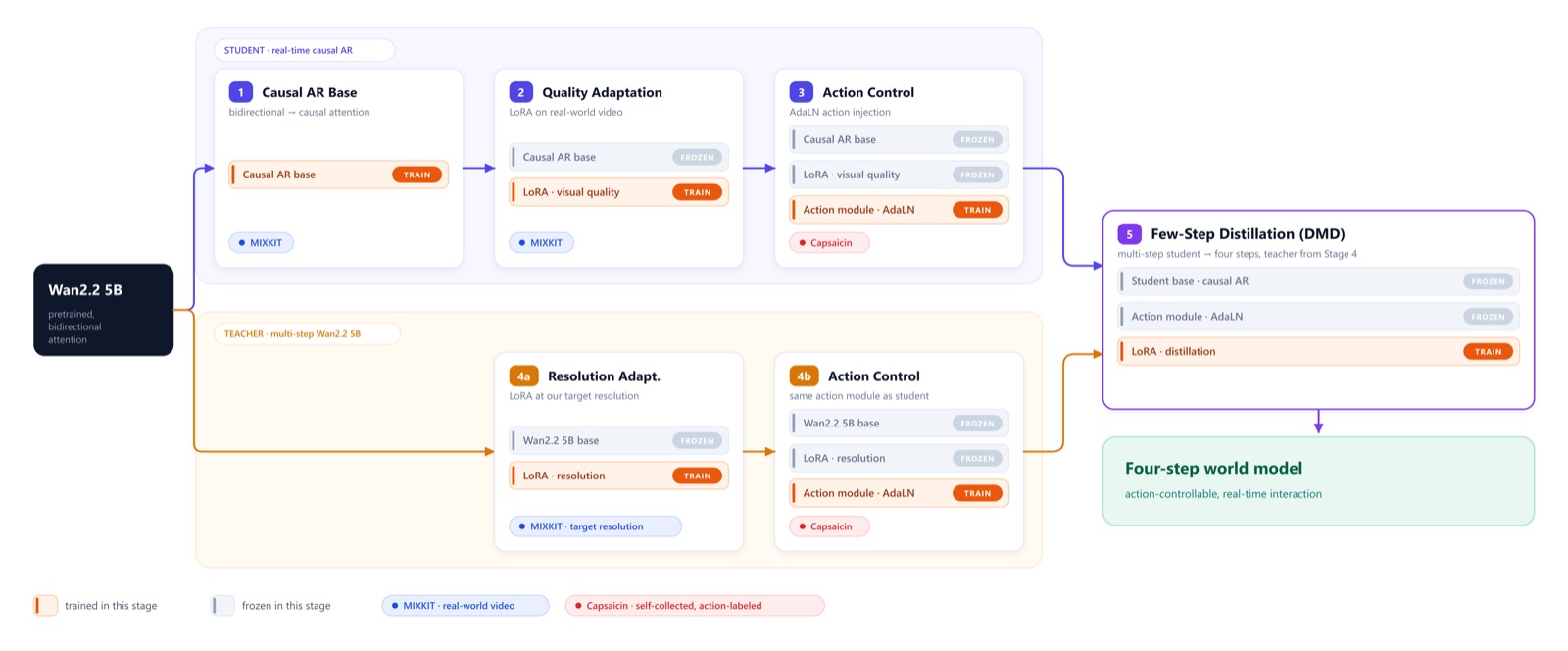
The model is causal: it predicts the next frames without seeing future ones, which is what streaming interaction requires. AMD trained it in stages. A causal base model came first, then a LoRA adapter for visual quality, then an action module that injects the controls into the network.
The last step is distillation. A multi-step teacher model is compressed into a student that denoises each chunk in four steps instead of dozens. That is where most of the speed comes from.
The training data is unusual. Rather than scraping gameplay video, AMD rendered 440 clips of 200 or 400 frames each in Capsaicin, its open-source real-time renderer, with scripted movement and a log of the exact action behind every frame. After filtering, every clip pairs pictures with precise controls.
The numbers
- 32.12 decoded frames per second with the standard VAE, and 42.49 with an optional lightweight decoder, on one MI350X.
- Training took about four days on eight MI350X GPUs.
- Clips can run for up to one minute of streaming generation.
- It scores 76.68 on the WBench average, ahead of Sana-WM at 76.00, and ranks first on 8 of the 21 metrics AMD reports.
These are AMD’s own benchmark results, from its own comparison table.
Limits
AMD is open about the gaps. Image quality is behind rivals: LingBot-World-V2-1.3B leads on WBench quality, and Sana-WM leads on image quality in the Mind Benchmark. Mouse-control accuracy is low, at 0.263 on the GameWorld Score. Output is small, and a minute is not a play session.
Our take
The model itself is modest. The recipe is the useful part. Training on engine-rendered clips with frame-exact action logs is a practical route for any studio that already has a game engine and wants a world model tuned to its own look and controls.
It also shows the hardware side of this field opening up. As we explain in how AI world models work, a world model is only usable if it keeps up with the player. A one-GPU, open-weight baseline that does so makes that easier to test.