Voice & performance
Drama 3: open-weight voice acting for games and interactive film
Fish Audio's new 35B text-to-speech model takes plain-language direction, voices up to 16 characters in one script and runs on your own hardware. It is the first open model that sounds like a cast rather than a narrator.
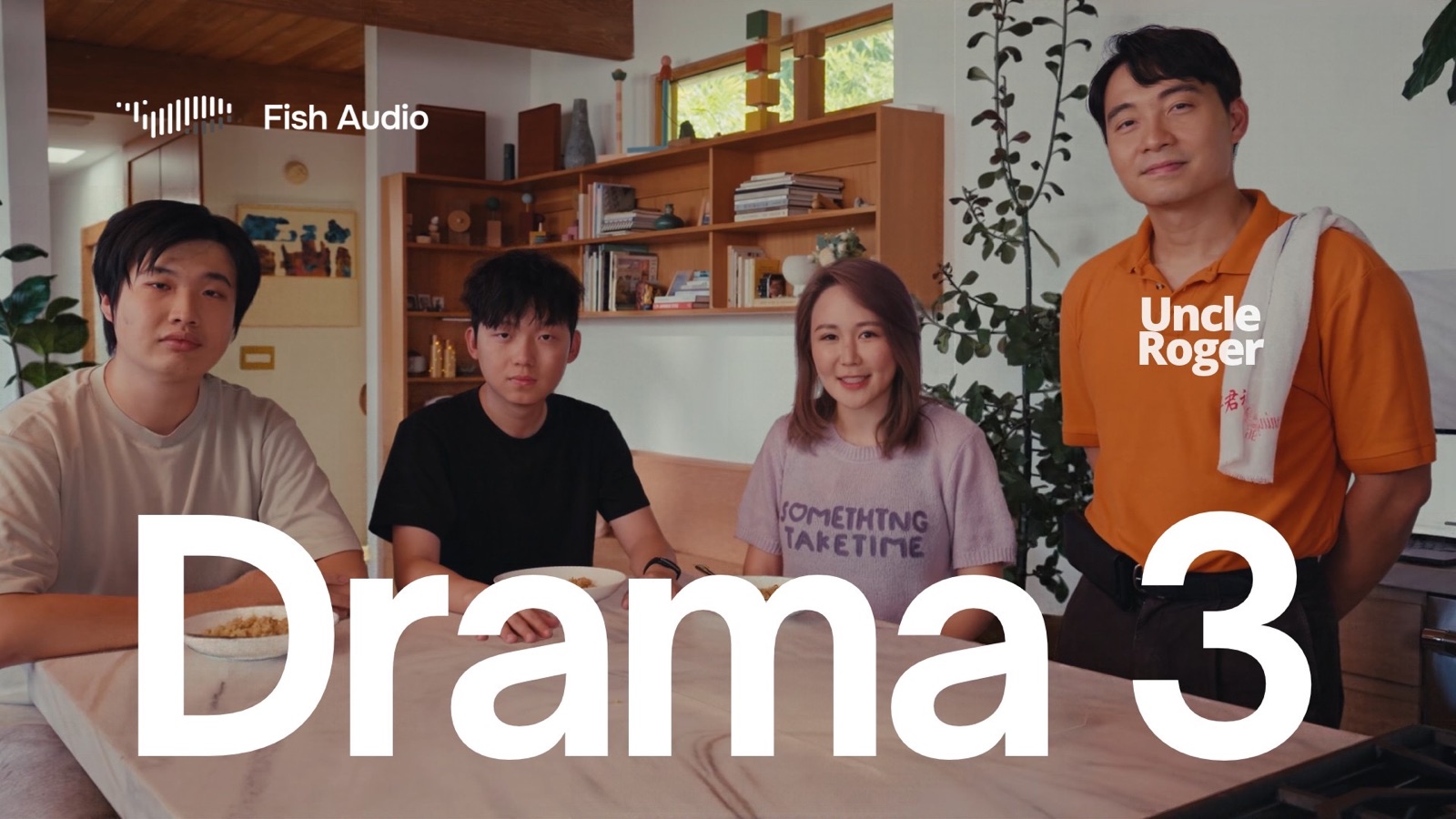
On 13 October, Fish Audio released Drama 3, an open-weight text-to-speech model built for scenes, not sentences. You direct it the way you would direct an actor, in plain words, and it plays the line the way you describe: a whisper, anger held in check, a laugh breaking through a straight face.
What it is
- 35 billion parameters, about 3 billion active per token. A mixture-of-experts backbone (8 of 256 routed experts plus one shared), initialised from Qwen3.5-35B-A3B. The technical report says it is the largest open-weight model dedicated to speech generation.
- Up to 16 characters in one text, each marked with a speaker tag, so a whole exchange renders as one performance.
- 83 languages. The direction does not have to match the language of the line: you can write the note in one language and direct a line in another.
- Editing and long-form streaming. Takes can be revised and continued rather than regenerated from scratch.
Fish Audio reports 93.2% on Artificial Analysis’ Pronunciation Robustness benchmark, top of that table at launch.
The licence matters
Weights are on Hugging Face under the new Fish Audio Community License v1.0: free for research and non-commercial use, and free for commercial use if you and your affiliates earn under US$500,000 a year. Above that, you need a commercial agreement. The hosted API lists at $50 per million characters, with a launch discount until 12 November.
Why it matters for interactive stories
Generated stories have always had a voice problem. Text can branch infinitely, but recorded dialogue cannot, so most AI-driven games fall back to text or a single flat narrator. A model that takes stage directions and holds a cast of distinct voices in one pass changes that. A scene can be written, directed and performed at runtime, in the player’s language.
It also raises the bar for direction. The quality now depends on the note you give: who is speaking, what they want, what they are hiding. That is a writing problem, which is exactly where story systems should be strong.
Our take
Voice is the layer that turns a generated scene into something that feels authored. Open weights mean studios can run performance locally, keep costs predictable and build consistent character voices over a long story. We expect directable speech to become a standard part of the generative story stack within a year.