World models
Tencent open-sources Hy-Nomas, a steerable world model
Hy-Nomas generates a video world one segment at a time, steered by text and camera moves, with Apache 2.0 weights and a single-RTX 4090 mode. It is a useful look at how open world models handle memory and control.
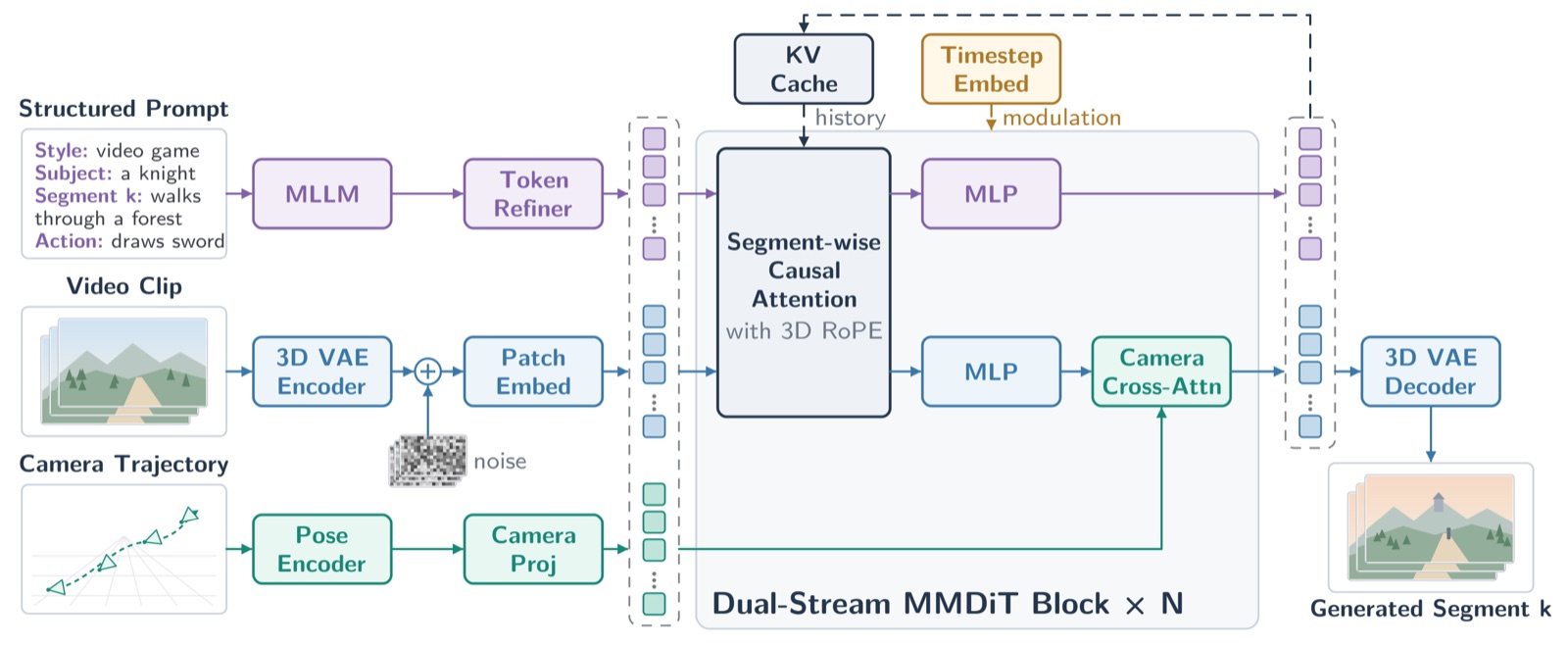
Tencent’s Hunyuan team has released Hy-Nomas, an open video world model that you steer while it plays. Instead of generating one fixed clip, it builds a world in short segments, and you can change what happens in each one with text or a camera path.
What it does
The model card describes a world generated “one video segment at a time”. Between segments you can introduce objects, change the style or scene, describe an action, or move the camera. The output is 720 × 1280 at 24 frames per second.
The prompts are structured. The repository’s examples describe a style, a perspective such as third-person, a list of subjects and timed segments, each with a description and actions.
How it works
Hy-Nomas combines a segment-autoregressive diffusion transformer, a Qwen text encoder, camera-conditioning modules and a video decoder. Diffusion happens inside each segment; autoregression happens across segments.
Memory is the key design choice. A persistent key/value (KV) cache carries context from earlier segments into the next one, so the world can stay consistent as it grows. The released distilled version uses 8 denoising steps per segment.
Tencent also published Hy-Nomas-Bench, a suite of four benchmarks with 280 test cases. They cover multi-turn text interaction, camera navigation, mixed text and camera control, and spatial memory.
What you get
Weights, training and inference code, and the demo code are released under Apache 2.0. The repository includes a cinematic LoRA adapter, a robotics LoRA adapter and instructions for fine-tuning your own. A web demo is live on the project page.
The standard setup uses eight GPUs in one inference group. A separate low-memory configuration runs on a single RTX 4090 by storing weights and the KV cache in INT8, decoding in FP8, bounding the history kept on the GPU and offloading models to the CPU.
Limits
Tencent lists a technical report as “coming soon”, so the training details are not yet public. The single-GPU path trades speed for memory: system RAM must hold the offloaded models and a growing history archive, and CPU-to-GPU transfers add latency. The card publishes no per-segment timing for the 4090, so we cannot say how close it gets to real-time play.
It is also a video model. It generates frames, not rules, so nothing in it guarantees that an object you picked up stays in your inventory.
Our take
Hy-Nomas is a clear example of the design question we describe in how AI world models work: how a model remembers what it has already shown you. A rolling KV cache with bounded history is a practical answer for visual consistency, but it is not authored canon.
For people building interactive worlds, the useful pattern is segment-by-segment direction. A game can send the model structured instructions, such as style, subject and action, while its own state decides what is true. An open, fine-tunable model with a consumer-GPU mode makes that approach easier to test.