Narrative design
AI narrative design: a new medium still waiting for its rules
The core loop already works. What nobody has built yet is the grammar: the conventions, structures and tools that turn a working trick into a medium. That is the job of AI narrative design now.
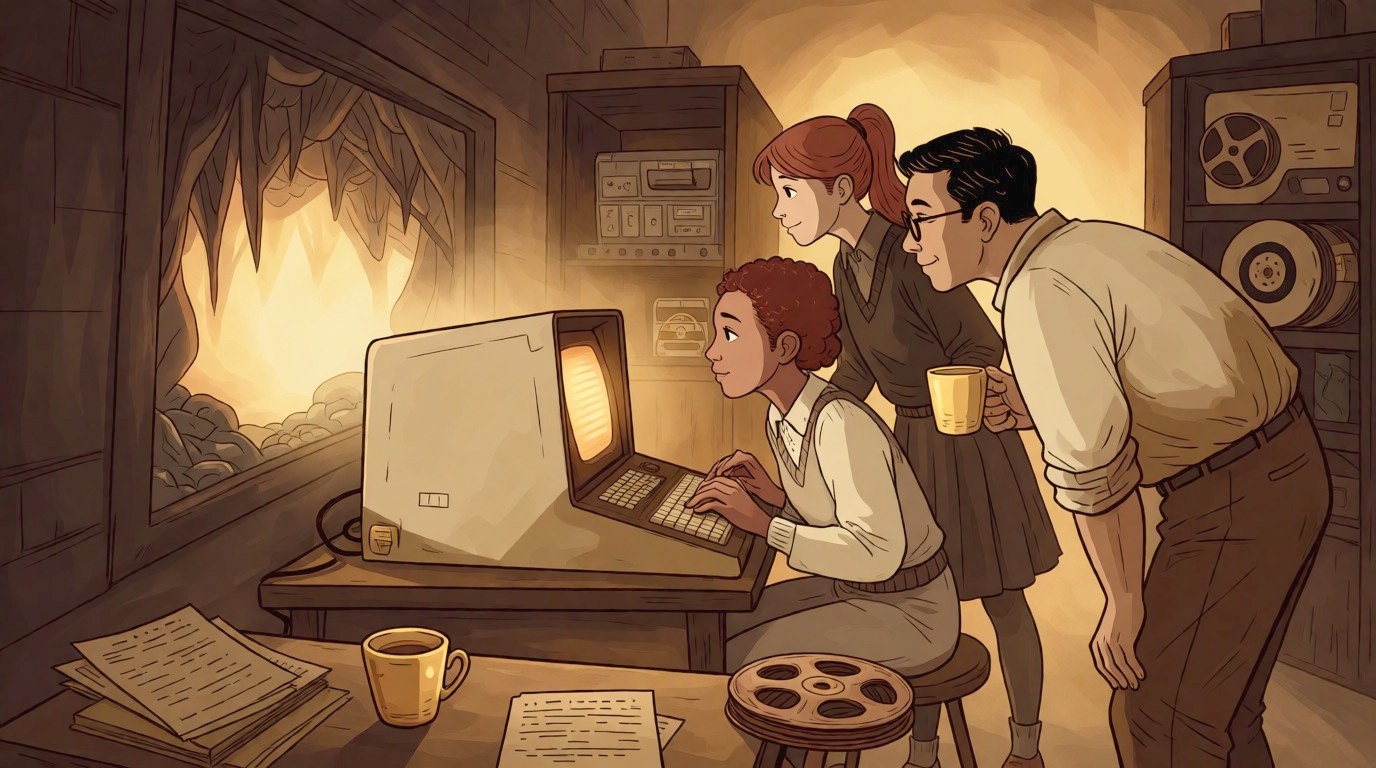
In the late 1970s, video games went through a quiet change of state. Arcade machines moved from hard-wired circuits to microprocessors and programmable ROMs. Vector screens drew glowing outlines of asteroids and spaceships. On university minicomputers, Colossal Cave Adventure and Zork let people type sentences into a world they could not see. The core mechanics worked. What nobody had yet was the grammar: the genres, the input conventions, the shapes a story could take. AI narrative design is at exactly that point today.
The comparison is not nostalgia. It is a description of a stage. Live, AI-performed stories already work: a player makes a choice, and a model performs what happens next, in character and in the world an author built. What the field lacks is everything that sits around that loop and makes it dependable. We call these works Story Generators, and we have set out what they are in our manifesto. This essay is about what it will take to design them well.
Not a game mechanic, and not a chatbot
There are two easy ways to misread the medium. One treats it as a classical video game with generated text bolted on: an AI character inside a scripted structure, still running on rules and content written in advance. The other treats it as a chat window, where the user writes half the story and the model writes the rest.
Neither is the thing itself. A Story Generator is generative, live storytelling from a canon. The author writes the world, its history and its characters. The model performs that canon live, every time someone plays. The player always has a real choice: where the next chapter goes, or what their character does and says. Seeing it this way moves the hard problems. The question stops being “how do we write enough branches?” and becomes “how do we write a world that can be performed faithfully forever?”

Continue reading for free
The rest of this piece is free with a Montage account. One account opens every essay, report and the full manifesto.
Create a Montage accountAlready have an account? Sign in