Generative gaming
What makes a game AI-native? A new survey draws the line
Researchers reviewed 53 publicly available AI-native games and propose a simple test: if you removed the AI, would the core of play collapse? Their roadmap is a useful checklist for anyone building one.
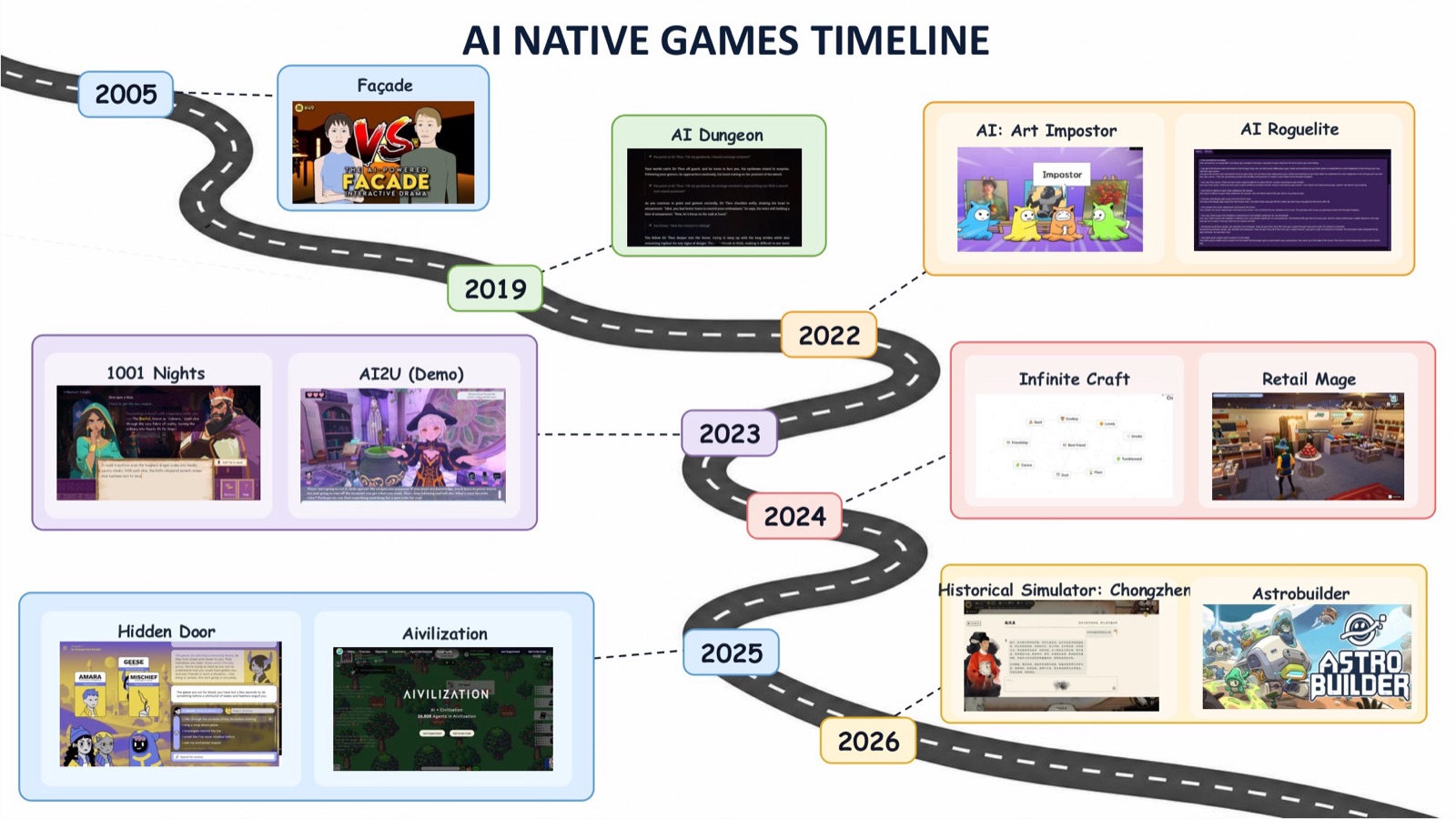
Plenty of games now use generative AI somewhere. Far fewer are built around it. A new survey, AI-Native Games: A Survey and Roadmap, offers a clean way to tell the difference: a game is AI-native if, with the AI removed or replaced by something trivial, the central form of play would collapse or become fundamentally different.
What they found
Applying that test, the authors analysed 53 publicly available AI-native games and prototypes and sorted them on two axes: the type of game the player sees, and the AI mechanic that makes generation indispensable.
The field is lopsided. Most titles are language-forward: narrative adventures, games about questioning and deduction, and open generative stories. Multi-agent simulation, generative construction and relationship or companion play are much less explored.
The real design problem
The paper’s sharpest point is that generation alone does not make something playable. The hard part is organising semantic openness into stable gameplay: goals, rules, state, feedback, pacing and player agency that make open-ended AI output interpretable and consequential.
That is the same conclusion we reach in Living worlds: let a system keep the books, let the model tell the story.
The roadmap
The authors close with priorities for the field: controllable generation, AI as a mechanic rather than decoration, multimodal and multi-agent systems, the economics of inference, evaluation, safety and regulation. It reads like a build plan for the next five years of the medium, and it is worth reading in full.