Simulation
Living worlds: why simulation is the next storytelling medium
The most compelling stories in games are increasingly the ones nobody wrote. Simulation, joined with generative models, turns worlds into places where stories grow on their own.
Ask players to tell you their favourite moment in a sprawling simulation game and you rarely hear about a cutscene. You hear about the time a minor rivalry spiralled into a feud, a trade route collapsed, or a character they barely noticed turned out to matter. Nobody wrote those stories. The world produced them.
Simulation has always been gaming’s quiet storyteller. What is new is that generative models can now narrate what a simulation produces, giving voice and meaning to events that used to stay as numbers in a spreadsheet. That combination is, we believe, a new storytelling medium.
Systems make events; models make stories
A simulation is good at consequences. Prices rise when supply falls. A character who is insulted remembers. Rain floods the low streets. But on its own, a simulation communicates poorly. The player sees a status change and has to imagine the drama.
A language model is the opposite. It is brilliant at drama and terrible at consistency. Left alone it will invent a flood that never happened and forget the one that did.
Put them together and each covers the other’s weakness. The simulation decides what is true. The model decides how it is told. The market crash is real, tracked and lasting; the gossip about it in the pub, the newspaper headline and the nervous trader’s confession are generated from that truth.
Let the simulation keep the books. Let the model tell the story.
Designing a world that writes itself
Building this kind of world asks different questions from traditional level design:
- What are the pressures? Scarcity, ambition, loyalty, surveillance, time. Stories emerge where pressures collide.
- What is remembered? A world without memory has no history and no consequence. Deciding what persists, and for how long, is central to the design.
- Who notices? Events only become stories when someone in the world reacts to them. Characters, factions, media and rumour are the sense organs of a simulated world.
- Where is the author? Emergent stories need boundaries. Canon, tone and a few authored anchor events keep a living world from dissolving into noise.
Scale without sameness
Procedural worlds have long suffered from a familiar flaw: ten thousand planets that all feel alike. Variation in geometry is cheap; variation in meaning is not. Generative narration changes that, because the same simulated event can be described from many perspectives, in many voices, with many implications. Two neighbourhoods with similar statistics can still feel like different places because the people in them talk about their lives differently.
A city as a character
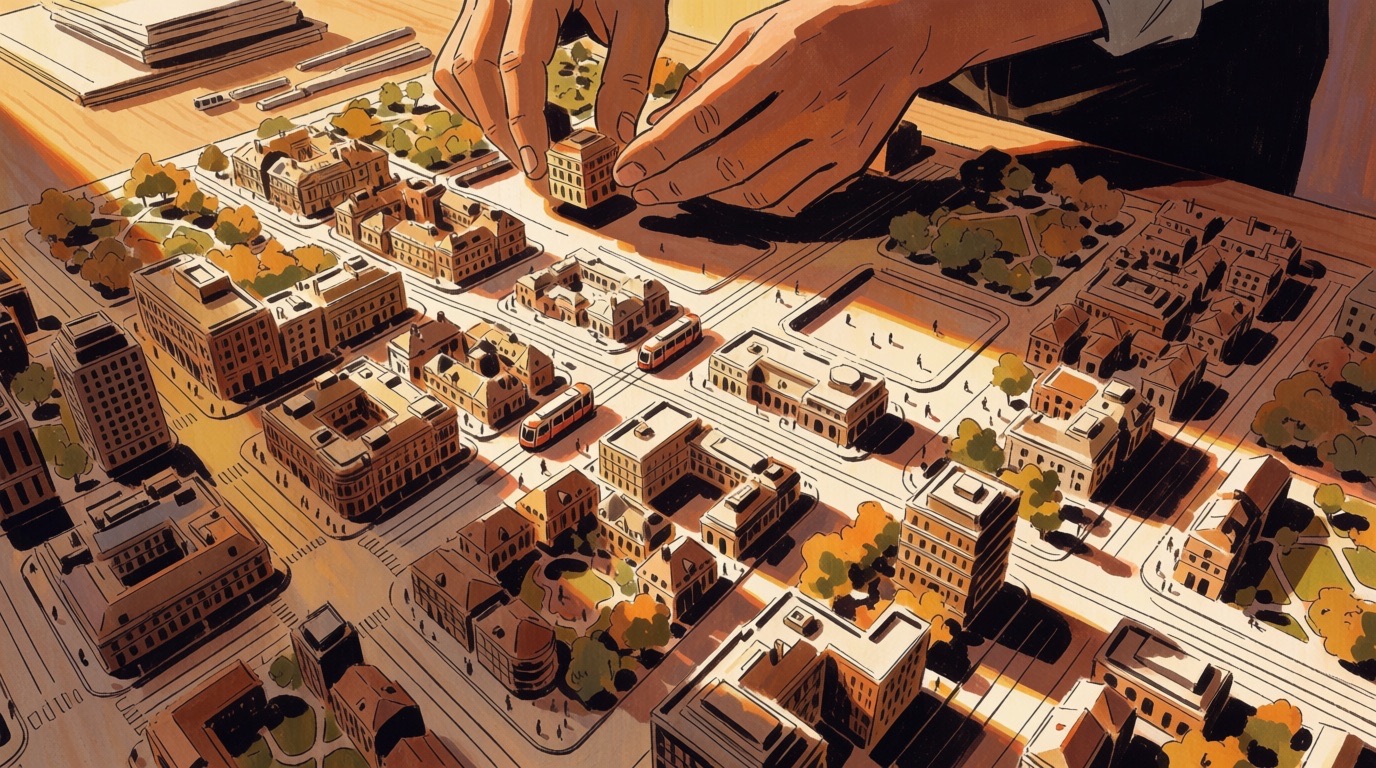
Our own work on city-scale experiences treats the city itself as a protagonist. Districts have moods, economies and histories. Day turns to night and the cast changes. Characters have homes, jobs and agendas, and the player is one more agent moving through it rather than the centre the world revolves around.
That humility is the point. A world that does not need you is a world that can surprise you.
What comes next
As simulations deepen and generative performance becomes cheaper and faster, the line between “game world” and “story” will keep blurring. The studios that lead will be the ones that can design pressures, memory and voice together, and that have the taste to know which stories are worth letting the world tell.