World models
EdenLive: open-source real-time generative renderer for games
VAST, the company behind Tripo, has open-sourced EdenLive, a model that turns rough greybox game footage into detailed video at 24+ frames per second. The game engine keeps the rules; the model only paints the picture.
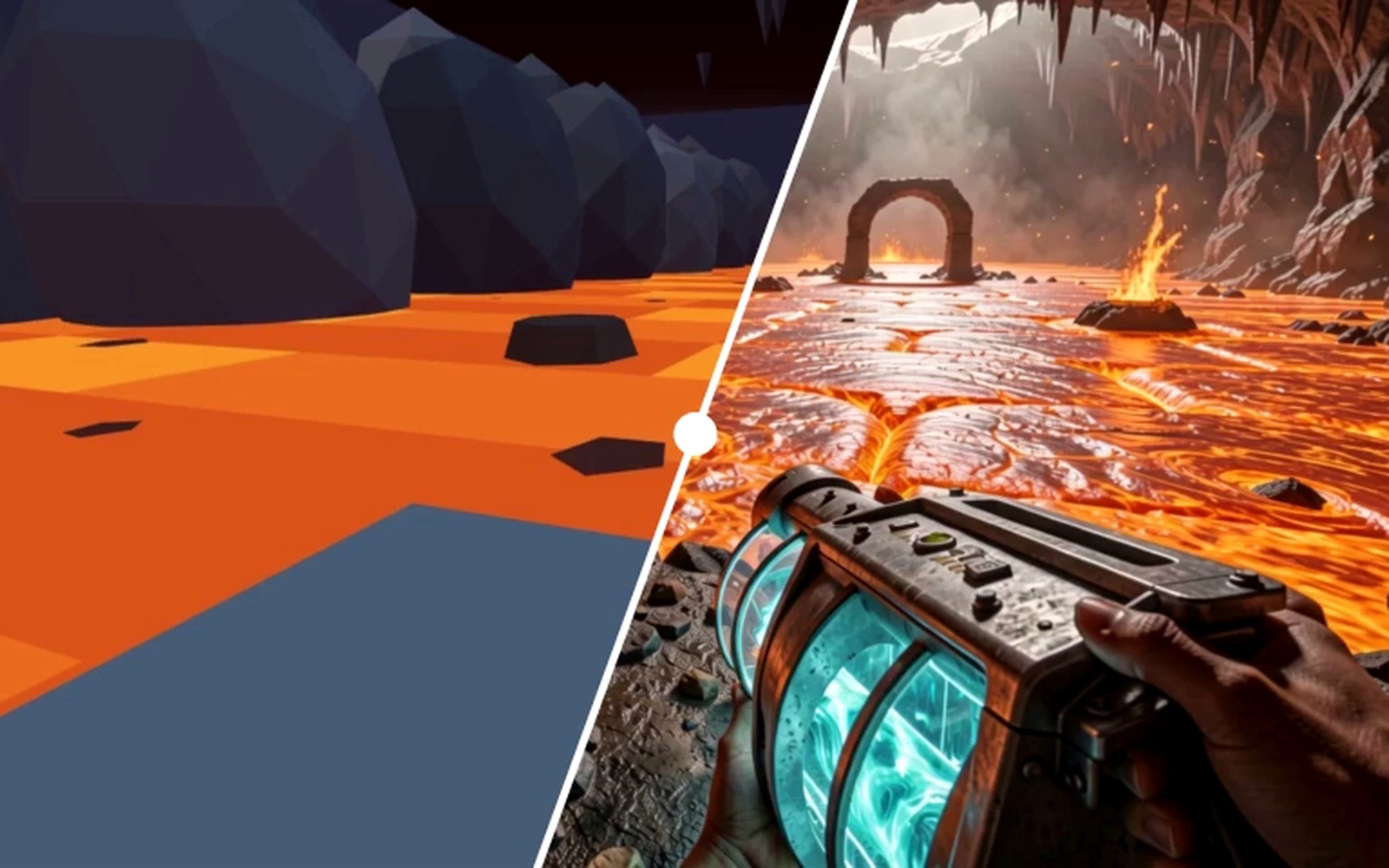
Most AI world models generate everything at once: the picture, the physics and the state of the game, all inside one neural network. VAST, the company behind the Tripo 3D models, has taken the opposite route with EdenLive, released as open source on 20 October 2026. It is a real-time renderer that leaves the rules to ordinary code and only generates the visuals.
What happened
EdenLive is part of VAST’s Project Eden, a world-model research programme. VAST published the code on GitHub, the weights on Hugging Face and a technical report. The release includes 5B and 14B parameter models, streaming inference code, and EdenGolem v0.1, an agent skill that turns a text prompt into a coarse playable game. A frontend for trying the full prompt-to-game pipeline is included.
How it works
A game engine or coding agent runs the game logic and keeps the world state. It outputs a rough reference video, such as greybox footage with simple blocks. EdenLive takes that stream, plus a target first frame and a text prompt, and renders it into detailed or stylised video.
Control is passed through a vision encoder: a post-trained DINOv3 model embeds each reference frame and conditions a diffusion transformer. For speed, the generator is distilled into a few-step model that works chunk by chunk over a bounded attention cache. The weights are built on Wan 2.1 and 2.2.
The result is that health, score, positions and rules stay explicit and exact, because they never pass through the image model.
The numbers
According to the project page and technical report:
- The 5B model runs at about 24.7 FPS at 1280×704 on a single RTX 5090.
- On one H100, the 5B model reaches 73.52 FPS at 832×480 and 29.80 FPS at 1280×704 (inference throughput).
- The 14B model reaches 26.76 FPS at 832×480 on eight H100s.
- First-chunk latency on one H100 is about 0.83 seconds at 480p and 1.16 seconds at 704p. The 95th-percentile gap between chunks is 148 ms and 392 ms.
- Output is 480p or 720p, and generation can run for minutes at a time.
Limits
The authors list three. The model does not explicitly tie reference objects to identities, so it can be unclear which proxy shape is meant to be which character. The bounded cache has no dedicated memory for fine appearance details, which matters after long occlusion or when revisiting a scene. And the encoder gives no control over how much reference detail is kept.
There are practical limits too. The full weights are about 210 GB, the verified setup uses Linux with 80 GB NVIDIA GPUs, and the first-chunk delay is noticeable. The real-time workbench also loads a FLUX model that is licensed for non-commercial use only, so check the licence of each component before shipping anything.
Our take
EdenLive is a clear example of the layered design we describe in AI models as game generators: one layer keeps the truth of the world, another performs it. Separating them means a studio can keep authored rules, saves and canon, and treat a generative model as a swappable renderer.
For people building interactive worlds, the useful idea is the interface. A rough, cheap, deterministic scene becomes the control signal for the look of the game. It also suggests a workflow where a world is designed as state first and skinned later.