World models
Fight World Model: game rules that drive a video model
Researchers from Oxford, Imperial, Tsinghua and NTU have published Fight World Model, which lets an ordinary game engine decide what happens in a fight and a video model draw it. The result is a generated game whose health bars and hit reactions follow editable rules.
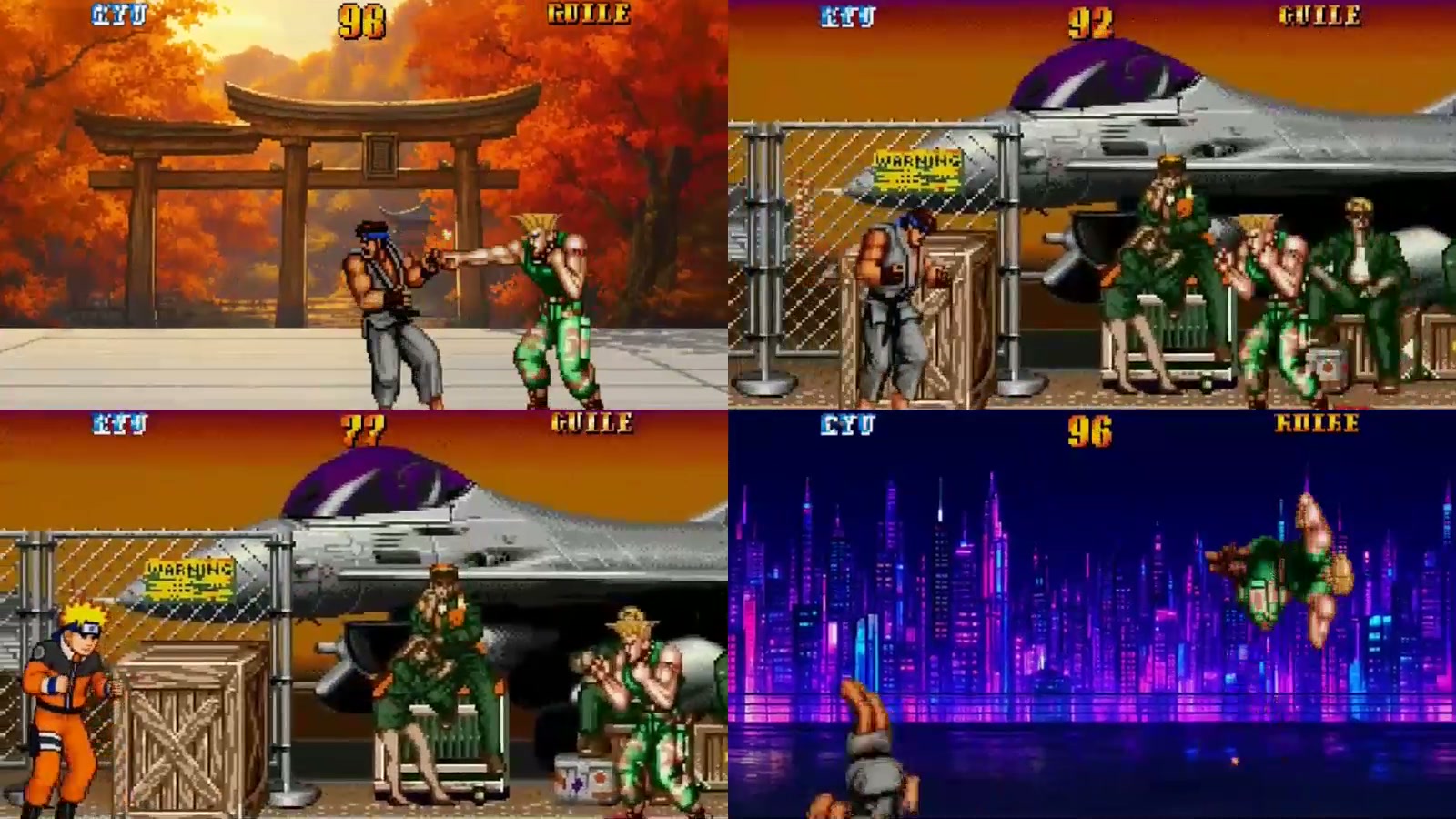
A research team has published Fight World Model (FWM), a system that splits a generated game in two. A conventional engine keeps score and decides what each hit does. A video model only paints the result. It is a paper with a project page and a code repository, not a product.
What happened
The paper (arXiv 2610.40607) appeared on 29 October. Its authors are from the University of Oxford, Imperial College London, Tsinghua University and Nanyang Technological University, plus independent researchers.
The problem it targets is familiar. Video world models can produce convincing fights, but they guess the consequences. Health drops before a projectile lands, or recovers for no reason, because the video model has to infer game state from pixels.
How it works
FWM keeps the rules outside the video model in three steps:
- Execute. A small combat engine resolves each hit and tracks health, protected hits and skill timing.
- Compile. A deterministic compiler draws those outcomes onto a “visual interaction proxy”: a coloured overlay on a shared timeline. Stripes mark punches and kicks, a block follows a character casting a skill, a brief colour inversion marks a hit reaction, and bar length records health.
- Render. A video diffusion model, initialised from Wan2.2-TI2V-5B, follows the proxy and reference images to draw the fight.
Because the engine owns the rules, they can be edited without retraining the renderer. The authors show damage scaling, immunity that blocks a set number of hits, lifesteal, and multi-stage skills that are not in the original game.
The numbers
All figures are the authors’ own, on two-fighter clips in the fixed 2D view of Street Fighter II.
- The training set, FightWorld Corpus, has 112,618 samples covering 52 skill effects, 187 character appearances and 15 arenas. Training used 128 H200 GPUs.
- In the main comparison, FWM scores 99.78%, 99.24% and 99.06% on move, attack and skill accuracy. The three baselines score between 16.67% and 85.53% on the same measures.
- Average health error is 0.15 percentage points of maximum health, against 4.04 to 8.75 for the baselines.
- Binding each reference image to its fighter lifts character adherence on side-switch clips from 53.68% to 98.27%.
Limits
It covers one game genre, two fighters and a fixed camera. Training clips are edited recordings of a single existing game. We did not find a frame rate or latency figure, so there is no evidence yet that it runs live. The rules are only as rich as the small engine behind them.
Our take
For anyone building interactive worlds, the useful idea is the division of labour. Rules, state and consequences belong in code you can inspect and change. The generative model supplies appearance. That is the argument in world model vs game engine, and it is also how a game becomes an intelligent product rather than a video that merely looks like one. Expect more papers to put an executable state layer under the renderer.