World models
Frameboy: World Labs' Atlas now explores worlds in real time
World Labs has put its Atlas world model into a browser demo that streams generated frames at up to 15 fps as you steer the camera. It is a research preview that runs on cloud GPUs, and it shows how fast generated worlds are moving towards play.
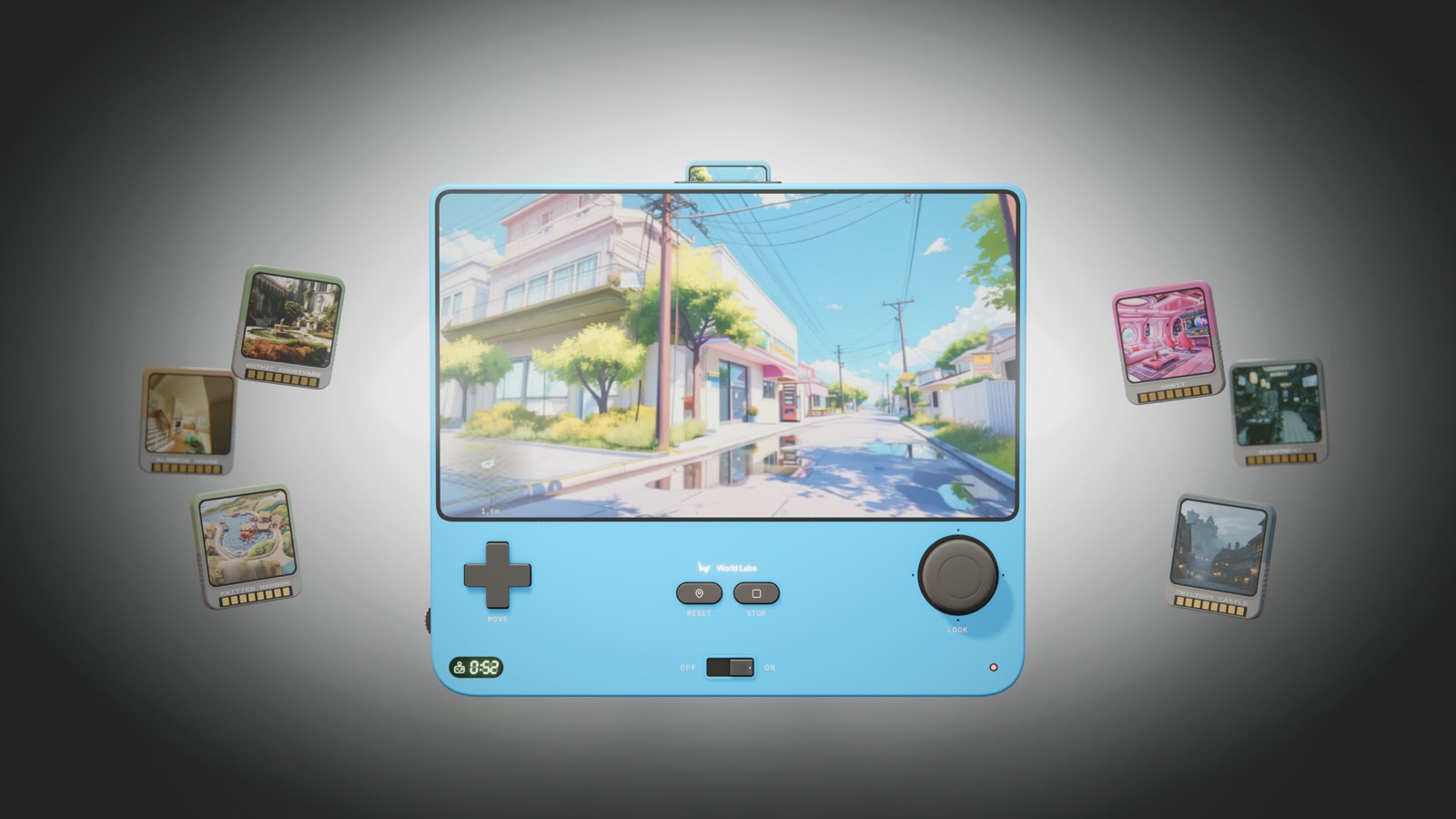
On 5 November, World Labs released Frameboy, a research preview that lets you explore worlds generated by its Atlas model in real time. The demo streams frames from cloud GPUs to your browser at up to 15 frames per second while you control the camera.
Atlas, introduced two months ago, is an autoregressive world model: it generates frames one at a time, with precise camera control. Frameboy serves a variant that World Labs says has been heavily optimised for fast, efficient inference while keeping strong novel view synthesis, meaning it can render views of a scene it has not been shown directly.
What you can do with it
Frameboy lets you explore a curated list of scenes. Some were seeded from a single input image, with Atlas generating extra viewpoints to fill out the rest of the scene. Others use multiview captures of real places, so you can walk around recognisable landmarks.
World Labs has also added the real-time mode to Viewfinder, a web app where you build a scene frame by frame with Atlas and then explore it live through a streaming Frameboy overlay. Viewfinder is in closed beta, with a waitlist.
Why speed matters
World Labs argues that waiting tens of seconds, or minutes, for a generated video makes people cautious. They plan camera paths carefully and iterate slowly. At an interactive rate, a bad idea costs almost nothing, so exploring replaces planning. Once latency drops far enough, users stop noticing a separate act of “generation” at all.
The company contrasts Atlas with RTFM, its research preview from last year. RTFM was designed mainly to interpolate between existing viewpoints. Atlas is far larger, trained on much more data, and can build a scene from scratch from one image or a text caption.
Limits
Frameboy needs a powerful cloud GPU server, and World Labs says plainly that it is not cheap compared with local rendering. There is no stated resolution, price, API or release date for a developer product. The demo is curated, so it does not show how Atlas behaves on arbitrary scenes. World Labs also does not describe long-term memory of a world, which remains the hard problem for the field.
Our take
The useful signal is the interaction loop, not the picture quality. A model that answers each camera move within a fraction of a second is starting to behave like a renderer, which is the idea we explore in how AI world models work and world model vs game engine. For interactive worlds, this is a strong tool for scouting and concept work today. Anything players return to still needs authored rules and persistent state underneath, as our earlier note on World Labs and AMD hints at on the compute side.