World models
PAN 2: an open 29B world model that simulates what happens next
MBZUAI's Institute of Foundation Models has released PAN 2 under Apache 2.0, with weights and full training code. Give it a scene and an action in words and it simulates up to 20 seconds of what follows.
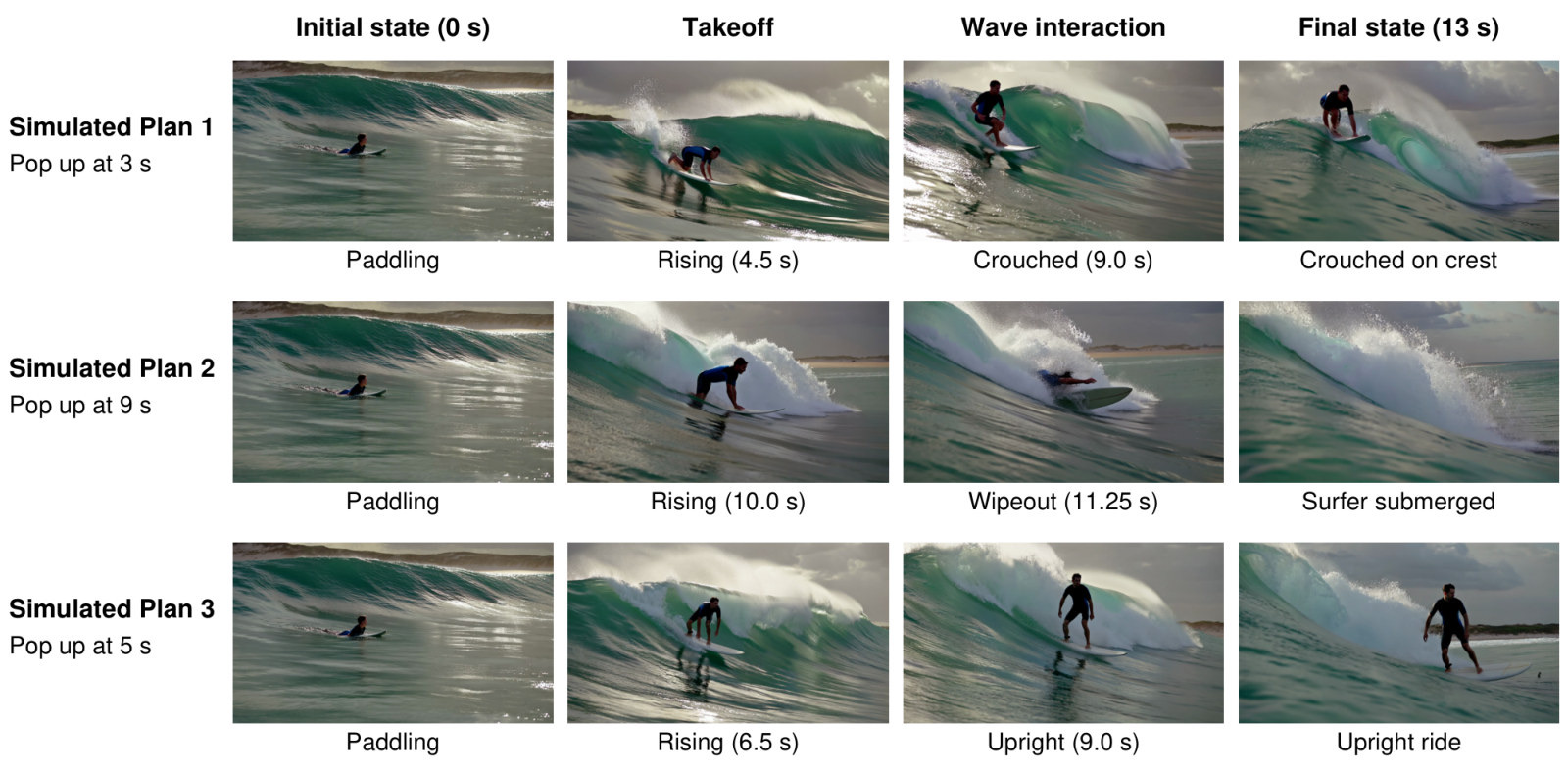
The Institute of Foundation Models (IFM), set up by MBZUAI, released PAN 2 on 10 November. It is an open world model: you describe a starting scene and an action, and it simulates a video of what happens next.
The pitch is “simulative reasoning”. An agent can imagine the result of several candidate plans, compare them and pick one, without trying each in the real world.
How it works
PAN 2 splits the job in two, following what IFM calls Generative Latent Prediction.
- Conceptual reasoning. A language model writes the next world state as a time-stamped description: who acts, when, and how the camera moves.
- Perceptual reasoning. A 29-billion-parameter video diffusion transformer, trained from scratch on hundreds of millions of videos chosen for physical dynamics rather than looks, fills in contact, deformation and motion.
The image above shows the idea. Three plans for the same surfer differ only in when they stand up. One ends in a ride, one in a wipeout.
What you get
- Output: 704x1248 video at 24 fps, up to 20 seconds, from text or from a starting image.
- Access: open weights on Hugging Face, full training and inference code on GitHub, all under Apache 2.0. Diffusers and vLLM support is listed.
- Parts: the text encoder (Qwen3.5-9B) and the Wan 2.2 VAE are downloaded from their own repositories under their own licences.
- Safety: IFM recommends running a separate guardrail. In its tests it cut unsafe outputs from harmful text prompts from 33.9% to 1.5%, and also blocked 11.5% of harmless text prompts.
The numbers
IFM reports that PAN 2 placed just behind MiniMax-H3 on its six-dimension physical-intelligence evaluation and ahead of four other models. It also reports third overall on the Physics-IQ Verified leaderboard and first among open-weight models. These are the lab’s own results.
Limits
The model card is direct about them. About two in three simulated multi-step plans contain at least one step that is not carried out. Each clip starts from one frame plus text, so appearance drifts across clips in a long interaction. And it simulates clips from a described plan, so it is not the keyboard-steered, real-time kind of world model.
Our take
PAN 2 is aimed at robotics and physical planning, but the idea carries over to games. A model that writes down what happens, step by step, before rendering it is closer to a director than a camera. That structure is what a story needs: a state you can read, edit and check.
For people building interactive worlds, the open code matters more than the leaderboard. Few world models ship with training code, which means studios can study and adapt one rather than rent it. The long-horizon drift is the same problem every world model has, and it is why we still keep authored state outside the model.