World models
SolarWM H3 Realtime makes a world model respond in 0.58 seconds
The SolarX team's engineering write-up shows how compilation, CUDA graphs and a streaming decoder took an open world model from 4.92 to 24.38 frames per second. The first frame after a keypress now arrives in about 0.6 seconds at the backend.
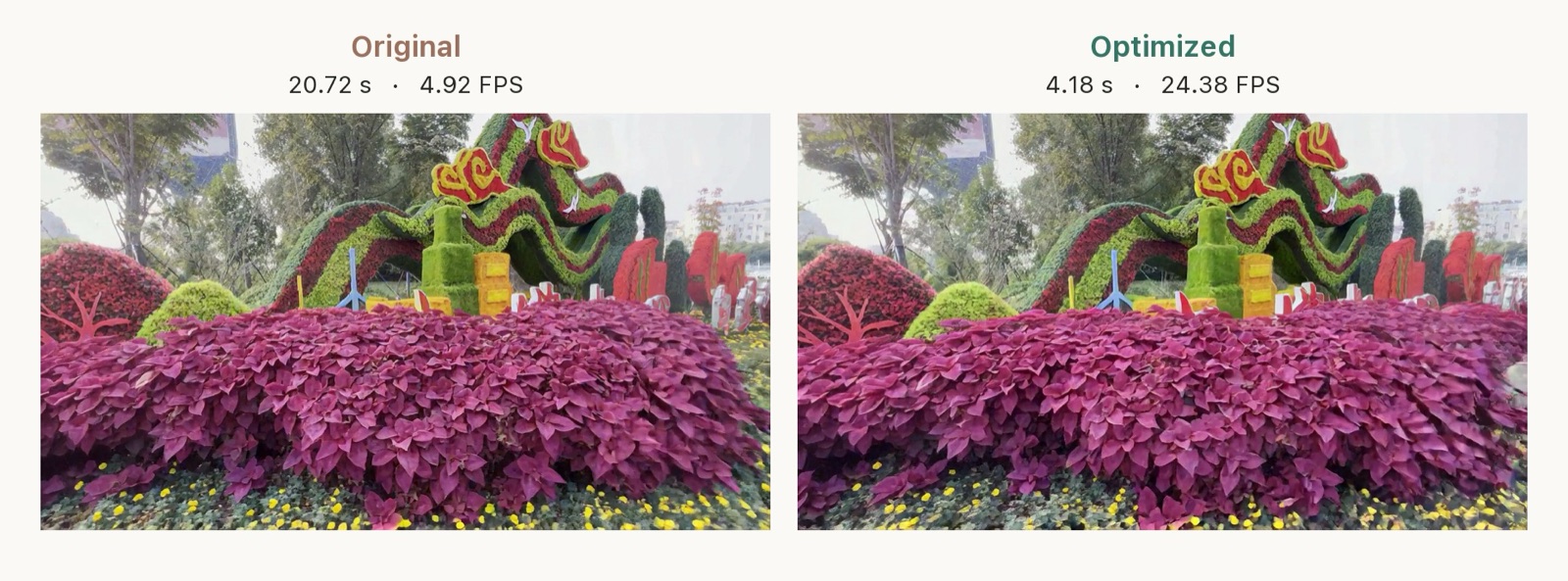
A world model that makes a beautiful clip is one thing. One that answers when you press a key is another. On 22 October the SolarX team released SolarWM H3 Realtime, an open implementation and engineering write-up that targets the second problem: the delay between an action and the frame that shows its result.
What happened
SolarWM is an open framework for interactive video world models, released in September with code, data pipeline and weights under Apache-2.0. The H3 variant is built on MiniMax’s H3 video model and generates video in chunks, steered by camera controls. The new release adds the inference work needed to run it interactively, with an image and a prompt as the starting point and real-time camera control.
How it works
Four changes speed up the diffusion transformer (the DiT), the most expensive part:
- Full-model compilation with
torch.compile, which fuses the many small operations across its 50 layers. - A different attention backend for the video queries (PyTorch SDPA, which ran on cuDNN Attention in their test), keeping FlashAttention for the other groups.
- Reusing packed history keys and values, so the same context is not reassembled for each of the four denoising passes.
- CUDA graph replay, which stops the CPU launching GPU kernels one at a time.
The fifth piece is the decoder. The original H3 decoder needs latents from the next chunk before it can show the current one. The team used NVIDIA’s StreamRender-H3 decoder, adapted by them to work from a single latent, so a response no longer waits for future computation.
The numbers
- DiT throughput: 7.09 to 31.49 equivalent frames per second (4.44 times faster).
- Full serial backend, including decoding: 4.92 to 24.38 frames per second (4.95 times faster).
- Time to the first frame responding to an action, at the backend: about 6.90 seconds down to 0.58 seconds.
- Median keypress-to-screen latency in their web demo: 1.15 seconds.
Limits
The 1.15 seconds is for a web deployment and includes generation, transfer and display. That is responsive for exploring a scene, but not the instant feedback of a game engine. The 0.58 seconds is the first frame only, not a full 17-frame chunk. The page we read does not state which GPU the figures were measured on, so treat them as relative speed-ups rather than a hardware target. Results come from the authors’ own tests, and the MiniMax H3 licence carries territory restrictions that the SolarWM code licence does not remove.
Our take
Most world-model news is about quality. This is about latency, and that is what decides whether a generated world feels like a place or a video. The gains here came from ordinary systems engineering, not a new architecture, which suggests there is more speed still to find. For anyone building interactive worlds, the question is moving from “can a model render this?” to “can it keep up with the player?” We explored that shift in The engine is learning to dream.