Video models
Tencent WeVisCut: a 9B agent that edits long videos
Tencent's WeVisCut is an open 9B-parameter agent that turns an article or narration script into a multi-minute edited video by calling 12 editing tools. It is not a text-to-video model, and it needs its own runtime.
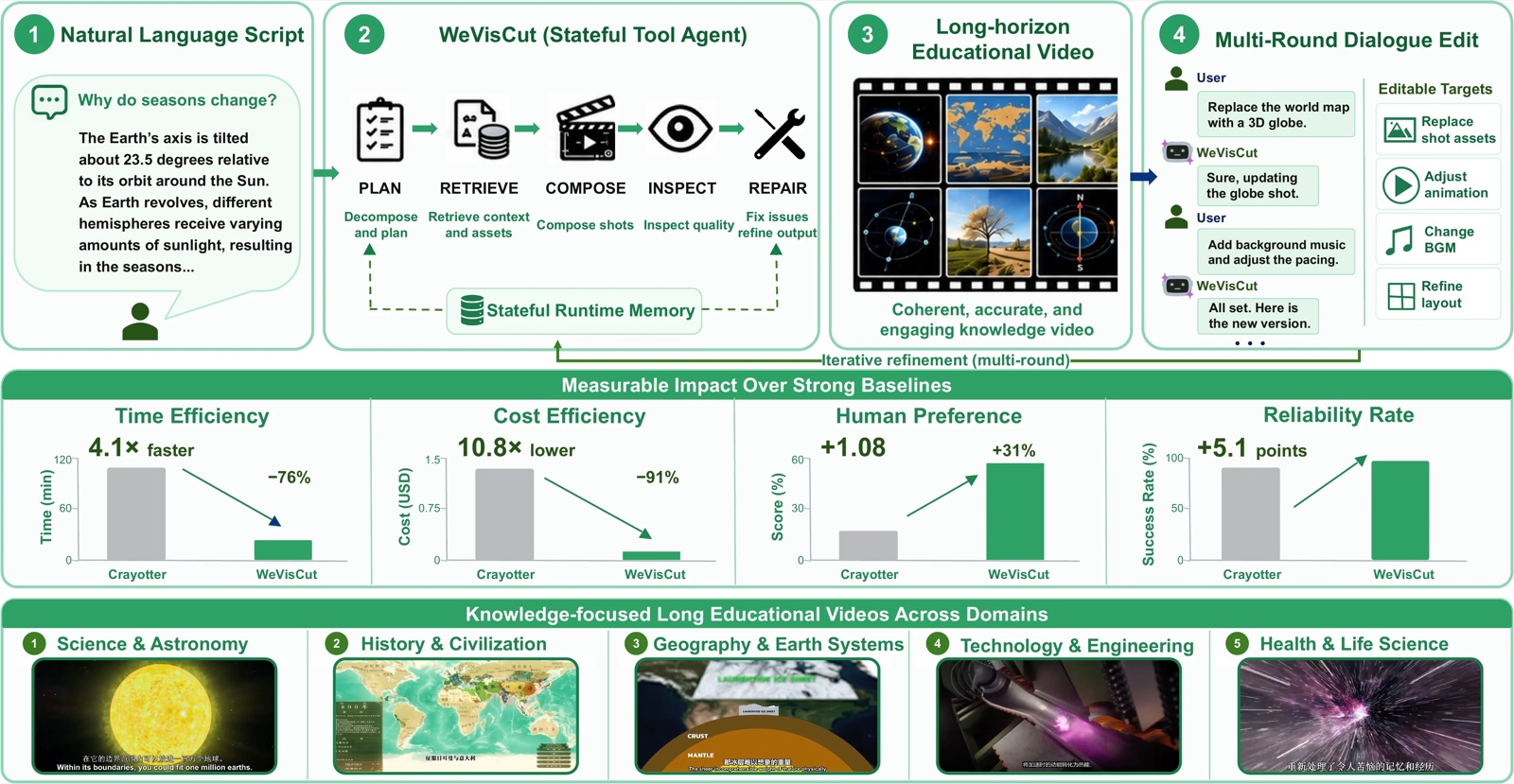
WeVisCut is a 9B-parameter tool-using agent from Tencent that turns a knowledge article or narration script into a multi-minute edited video. The paper (arXiv 2610.38352) appeared on Hugging Face Papers on 28 October 2026, with the model weights and runtime published on Hugging Face and GitHub.
What it is, and is not
WeVisCut is built on Qwen3.5-9B. At each step it reads the current editing state and picks one of 12 tools for planning, narration, asset retrieval, composition, inspection or repair, roughly 12 calls per video. The model card is explicit that it is “not a standalone text-to-video model”. It decides what to do; footage, speech and rendering come from other services the runtime connects.
The runtime includes a Studio with an editable timeline. You can pause and resume, revise by hand or by chat, re-render a single shot and roll back to an earlier version. Tencent’s gallery shows three finished films of between 3 and 6 minutes, such as how rockets reach orbit and how trees lift water.
The numbers
The team trained the policy on over 130,000 examples recovered from 3,750 finished videos, using a method it calls editing inversion with verified replay. On its own 100-task benchmark, the project page reports:
- An overall score of 90.5, against 89.9 for Claude Opus 5 and 84.6 for Gemini 3.1 Pro under the same tools.
- 2,377 tokens per successful output minute, against 78,763 for Claude Opus 5, which the paper calls nearly 33 times fewer.
- Against the native editing system Crayotter: 2.1 minutes of wall time per output minute against 8.6, and $0.09 against $0.97 per output minute.
The benchmark and metrics are the authors’ own.
Access and limits
The code is Apache 2.0. The model card’s licence is listed as “other” and says weights and third-party components follow their own terms, so check before commercial use. The README suggests a GPU of about 24 GB for the 9B model in bf16. Tencent warns that it does not guarantee factual accuracy or production quality, and that quality depends on the retrieval, text-to-speech and rendering services you configure.
Our take
This is a small, cheap model doing orchestration: choosing tools, checking results and repairing failures, rather than generating pixels. That pattern matters for interactive worlds, where a lot of the work is coordinating voice, art and logic over many steps without losing the thread. It suggests that a compact, well-trained controller can run a pipeline that once needed a frontier model. We look at games built this way in games as intelligent products.