World models
PlayGen2: a playable world model with explicit 3D state
PlayGen2 is a research world model that keeps a persistent 3D map of the game world and uses a separate neural renderer to draw it. Code and weights are public, and the Doom demo runs at about 160 ms backend latency on a MacBook Pro.
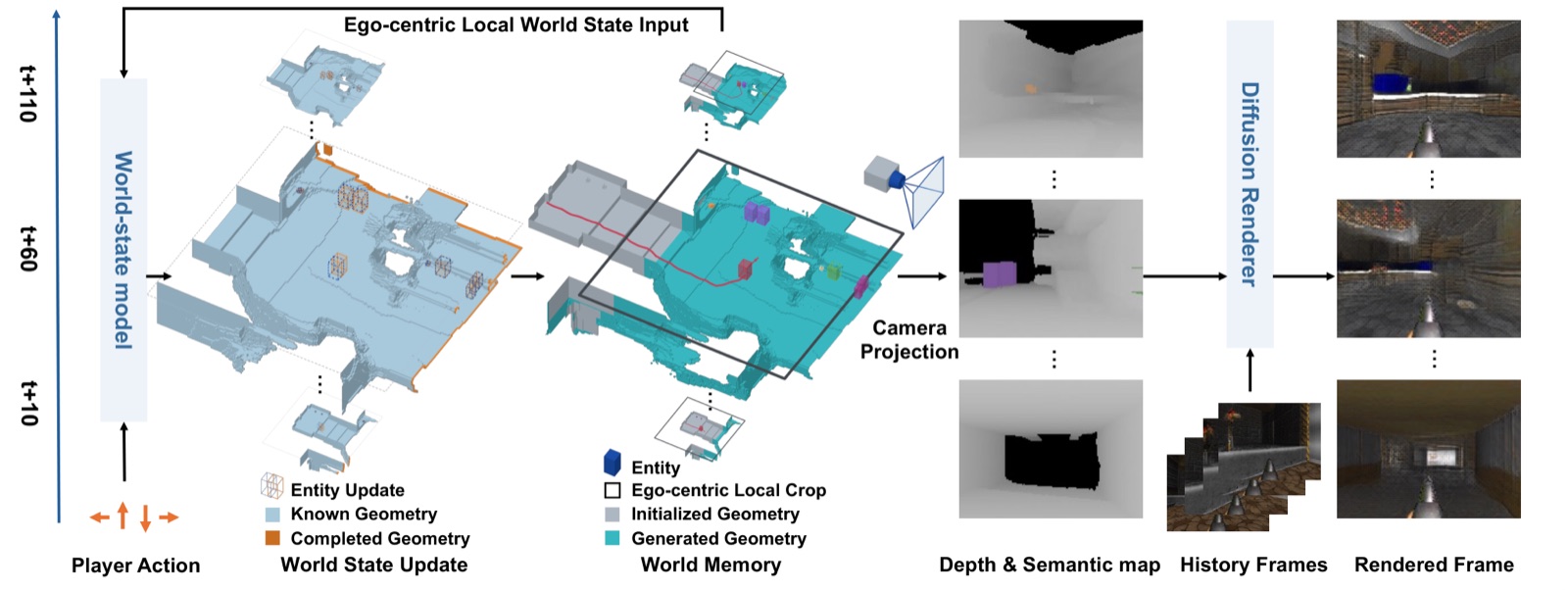
A paper posted to arXiv on 5 November describes PlayGen2, a real-time interactive world model built around an idea game engines have always used: keep an explicit state of the world, and draw it separately. The authors are from The Chinese University of Hong Kong, Tencent and Nanyang Technological University, among others, and the paper says code and pretrained weights are public.
What it does differently
Most generated-game systems use the video frames themselves as the model’s memory. That makes the same signal responsible for geometry, characters and appearance, and errors in earlier frames spread into later ones.
PlayGen2 splits the job in two:
- A world-state model keeps a persistent world memory: static geometry as a volumetric occupancy grid, plus identity-tracked 3D states for the player and other entities. Within a fixed-size local region it predicts how entities move in response to player actions, fills in missing geometry and finds new entities.
- A neural renderer turns depth and semantic projections of that state into first-person frames. Generated images are never fed back into state prediction.
What the demo shows
The testbed is Doom. The authors report that the model learns geometry-aware player movement and player–NPC interactions. They also show three extensions:
- zero-shot play on Doom maps it had not seen;
- multiplayer, built by composing single-player models;
- programmable gameplay, where a rule-based change to the state alters what happens.
On efficiency, the paper reports roughly 160 ms backend latency for the full simulation and rendering pipeline on a MacBook Pro with an M4 Pro chip.
Limits
The only game tested is Doom, a simple world with a fixed set of entity types. The paper’s renderer metrics are reported at 160 by 120 pixels, which is low resolution. It is a research result, not a product, and says nothing about narrative, dialogue or rules written by designers beyond simple state interventions.
Our take
The interesting part is the argument, not the pixels. Separating a readable world state from rendering gives designers something they can inspect and edit, which pure frame-by-frame models do not. That is the dividing line we draw in world model vs game engine, and it speaks to the persistence problem in memory in AI games. If hybrid designs like this scale beyond Doom, authored rules and learned rendering may end up in the same pipeline. See also our note on TouchéWorld for another route to controllable generated worlds.