World models
SWAM: a world model that keeps NPCs moving off-screen
New York University researchers split character state from video generation, so non-player characters keep acting while out of view and reappear where they should. Tests in a small Godot shooter show gains over two baselines.
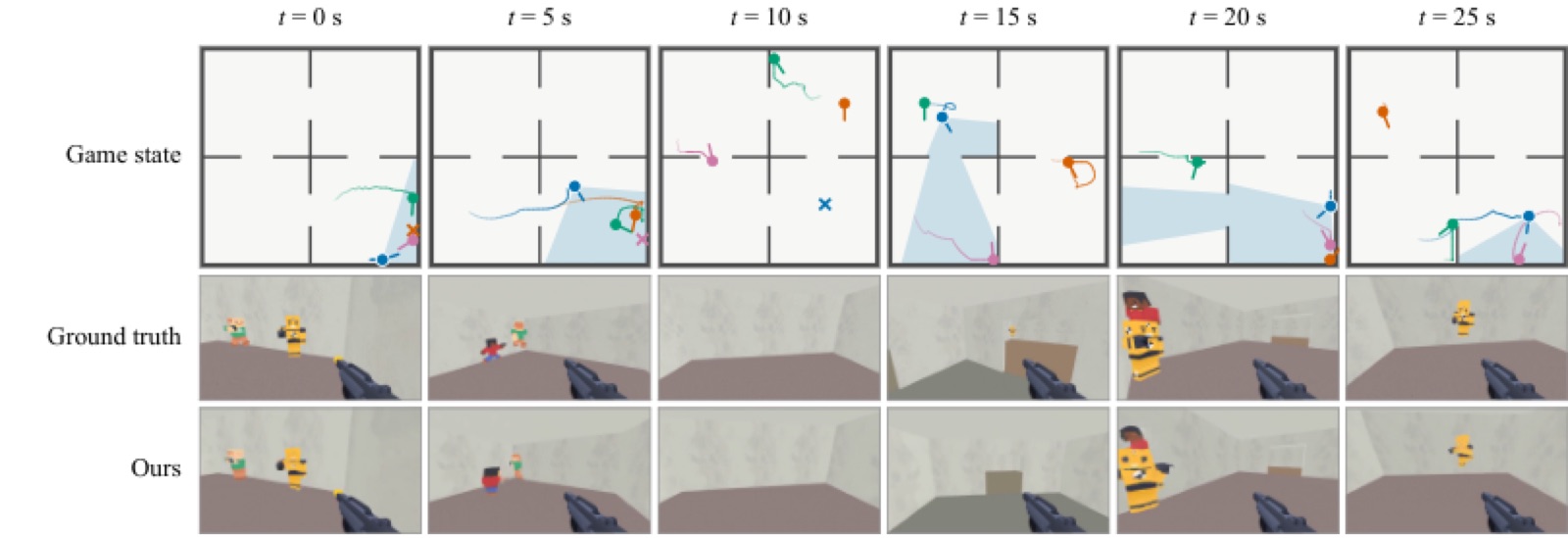
A team at New York University submitted SWAM, the State-aware World Action Model, to arXiv on 23 November 2026. It targets a weak spot in interactive world models: what happens to a character once it leaves the camera’s view.
The problem
Most generative world models predict the next frame from earlier frames and the player’s actions. If an NPC walks behind a wall, nothing in the frame history says where it went. When it reappears it may be somewhere impossible, or look different, or be gone.
How SWAM works
SWAM separates two jobs:
- A lightweight state model tracks each character’s position, velocity, view direction and whether it is on the ground. It uses motion priors plus learned, scene-dependent corrections, and it never reads generated frames.
- An autoregressive diffusion transformer generates the video. It sees the visual history plus the predicted character states, projected as a field-of-view mask that shows where characters may appear.
Because the mask only says where a character might be, the model learns appearance and occlusion itself. No scene map or visibility test is needed, which earlier multi-agent approaches relied on.
What the authors report
The testbed is a custom Godot first-person shooter with four PPO-trained bots, in a 20 m by 20 m arena. In the authors’ tests:
- Over 30-second rollouts, SWAM cuts LPIPS by 28% against a model with no state.
- At 10 seconds, player recall is 74.5% against 45.7% for the no-state baseline and 39.4% for Solaris, a joint multi-view model.
- Time per frame is 158 ms, close to the baseline’s 160 ms and well under Solaris at 960 ms. That is still several frames a second per view, not real time.
- The state model’s error is about 0.7 m after a 10-minute rollout.
The metrics use the game engine’s true player states, so drift in predicted states does not distort the scores. End-to-end results are in the paper’s supplement.
Limits
Training needs synchronised video, actions and ground-truth NPC states, which ordinary video datasets lack. The authors built their own game to get them. NPC positions and orientations are sometimes wrong over long rollouts. And the test is one simple-looking shooter, so scaling to varied, detailed games is untested.
Our take
Generated worlds only feel inhabited if characters live on while you look elsewhere. SWAM keeps that bookkeeping in a small, cheap model and lets the video model paint it, which echoes how a world model relates to a game engine: something separate holds the truth.
It points toward intelligent NPCs in generated worlds, where an authored or learned state model decides what characters do and the picture follows. Today it is a small research result, not a product.