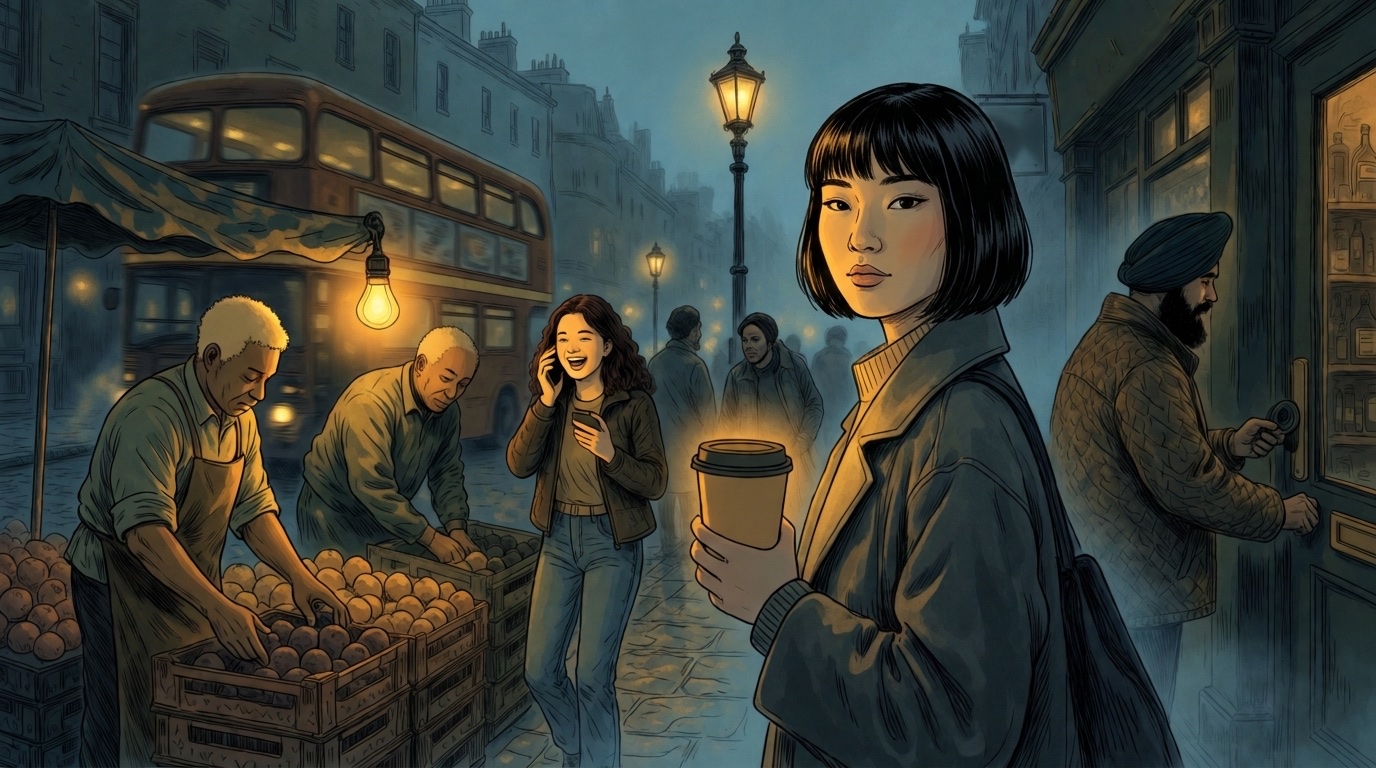
For as long as there have been simulation games, players have wanted the little people inside them to be real. We name them, build them houses, watch them fall in love and fall out, and invent stories in our heads to explain what they do. The games give us routines, needs bars and a handful of animations. We supply the inner life.
That is about to change hands. Language models can now perform a character, live, from what a writer has said about them: their past, their temper, what they want and what they are hiding. Put those characters in a world, give them memory and let them act, and the inner life no longer has to come from the player. It comes from the world. This is our case for treating AI simulations as their own form, and for a new word for the people who live in them: simulants.
Two ideas meeting
Two lines of interactive entertainment are converging. One is the simulation: a world that runs by its own rules, where the player tends, steers or lives inside a system rather than following a plot. The other is the Story Generator: a work in which an AI model generates story and dialogue live, from the player's choices, while staying bound to an authored canon. We set out the second in our Story Gen manifesto.
Simulations have always had worlds and no writers in the room. Story Generators have writers in the room and, so far, mostly text. An AI simulation is what happens when the two meet: a world with characters and action, in 2D or 3D, where the story is generated from what the characters and the player actually do.
Defining - Simulations
By an AI simulation we mean an interactive world in which characters are performed live by AI models from an authored canon, act on their own goals inside the world's rules, remember what happens, and generate story through what they and the player do.
- It is a world first. A place with geography, time, institutions, money, weather and history. The world exists before the player arrives, with its own history and people already in motion.
- It is character- and action-based. The player acts in the world, in a 2D or 3D space, beside people who also act. Reading and writing can be part of it; they are not the core of it.
- It has a canon. As with every Story Generator, a studio or author has written the world and its people. The model performs that canon; it does not replace it.
- Story is an output, not a track. There is no single plot to follow. Story is what the simulation produces when characters with goals meet a player with choices.
Player and autonomous simulations
There are two kinds. In an autonomous simulation the world runs on its own: time passes and its people act whether anyone is watching or not, and the player observes or visits. In a player simulation the world moves with the player. Time advances through what the player does; while they play, simulants pursue their own goals around them, and when the player puts the world down it pauses and waits, exactly where they left it. Our focus is the player simulation: the player is the reason the clock runs, without being the reason the people exist.
This is the line we draw between our two kinds of work. People who want to read, write and generate stories are served by Story Generators in their Story form. People who want to live in a world, act in it and watch it respond are served by simulations. The audiences overlap less than you might think, and each deserves a form built for it.
Where simulation meets story
Classical simulation games are rich in systems and poor in story. Their characters have needs and schedules, and their drama is emergent: a fire, a quarrel, a promotion. It is real drama, but it has no author. It cannot remember why a character is the way they are, because no one ever decided.
Story-led games have the opposite problem. They are rich in story and fixed in shape. Every character has an author, a past and a voice, but their lives stop at the edge of what was written. Step off the path and the world goes quiet.
An AI simulation takes the strength of each. From the simulation it takes a running world and characters with needs and routines. From story generation it takes canon, voice and live narrative: the ability to explain, in the character's own words, why they did what they did, and to turn a sequence of events into a story with meaning. The world produces events; the generator gives them a narrator, a memory and consequences. That is where a simulation stops being a toy and starts being a story.