World models
WorldPager: 37 minutes of world-model memory on one GPU
A Chengdu team has published WorldPager, a memory system that spills a world model's long-term memory onto an SSD. On one RTX 4090 it kept a Matrix-Game 2.0 session going for 37.5 minutes of video, up from 45 seconds.
Interactive world models can now remember the places they have shown you. The catch is that the memory is large, and on a single home machine it runs out quickly. Researchers at the University of Electronic Science and Technology of China have published WorldPager, a system that keeps that memory on a solid-state drive instead. It is a paper, not a product, and the authors do not link a code release.
What it does
Many interactive world models generate video in short chunks. To keep a revisited place looking the same, they store the attention keys and values (the KV memory) of earlier chunks and look up the ones whose camera position matches the current view.
The team found two limits on one RTX 4090 with 32 GiB of system memory, using Matrix-Game 2.0 as the test model:
- Capacity. One 0.75-second chunk needs 486.6 MB of KV memory at standard precision. Host memory runs out after 45 seconds of video, or after 2.8 minutes if the memory is compressed to int4.
- Position range. The model’s position table covers 4.3 minutes, so generation fails there whatever the memory system.
How it works
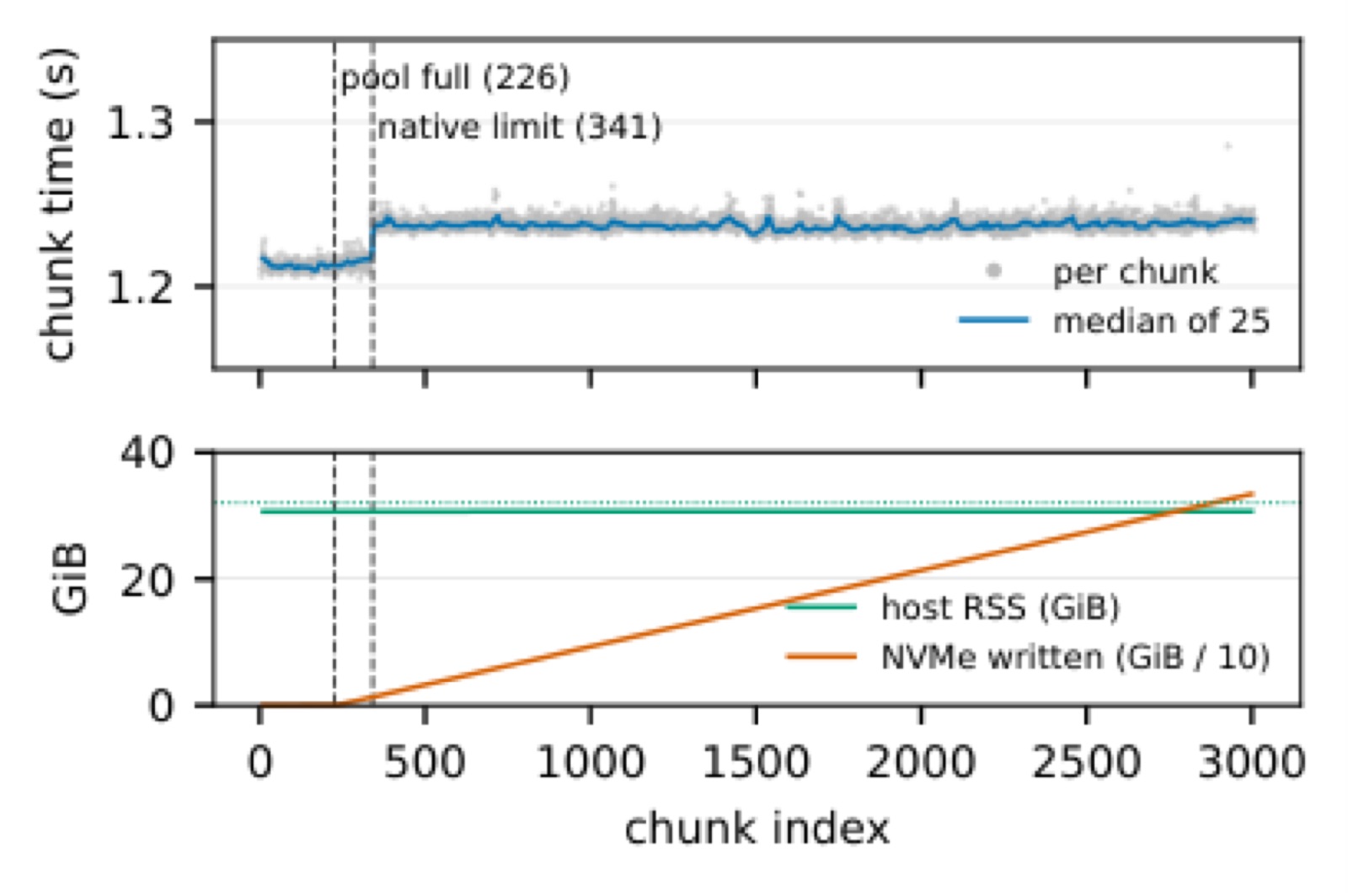
The authors argue the problem is capacity, not bandwidth. A chunk takes about 1.2 seconds to compute, which is long enough to read the stored memory from an SSD many times over. The lookup key is also the camera pose, which follows from the player’s controls, so the system knows which memory it will need one chunk ahead.
WorldPager therefore stores int4 memory across the GPU, system memory and an NVMe drive. It prefetches the next chunk’s memory while the current one is being generated, falls back to the previous set if a read is late, and writes data back in the background. A training-free change to how positions are handled extends the usable range.
The numbers
- One session ran 3,000 chunks, or 37.5 minutes of video, with zero stalls and constant host memory.
- The int4 storage showed no measurable quality loss on the authors’ sealed test set. On long-gap revisits, image quality dropped by about one MUSIQ point.
- The authors’ first-order model predicted where memory would spill to within one chunk on the held-out settings they tested.
Limits
This is not real time. The 37.5 minutes of video took about 63 minutes to generate, roughly 9.5 frames per second. All timings come from one machine and one drive, and the quality results cover Matrix-Game 2.0 only. On LingBot-World, retrieval did not improve consistency, so the paper reports only system measurements there. The authors also report a repeated texture that appears after about 100 chunks, whatever the memory precision.
Our take
For anyone building interactive worlds, the useful point is that long-term consistency is partly a plumbing problem. A world that remembers where you have been needs memory that grows with your session, and a consumer machine can only hold so much of it. Moving that memory to disk is a practical route to longer sessions on hardware players already own, though not yet at playable speed. It also concerns only visual memory of places. What characters remember about you is a separate problem, which we cover in memory in AI games.